






the Most Beautifully Designed Solo Bitcoin Miner I’ve Ever Seen!
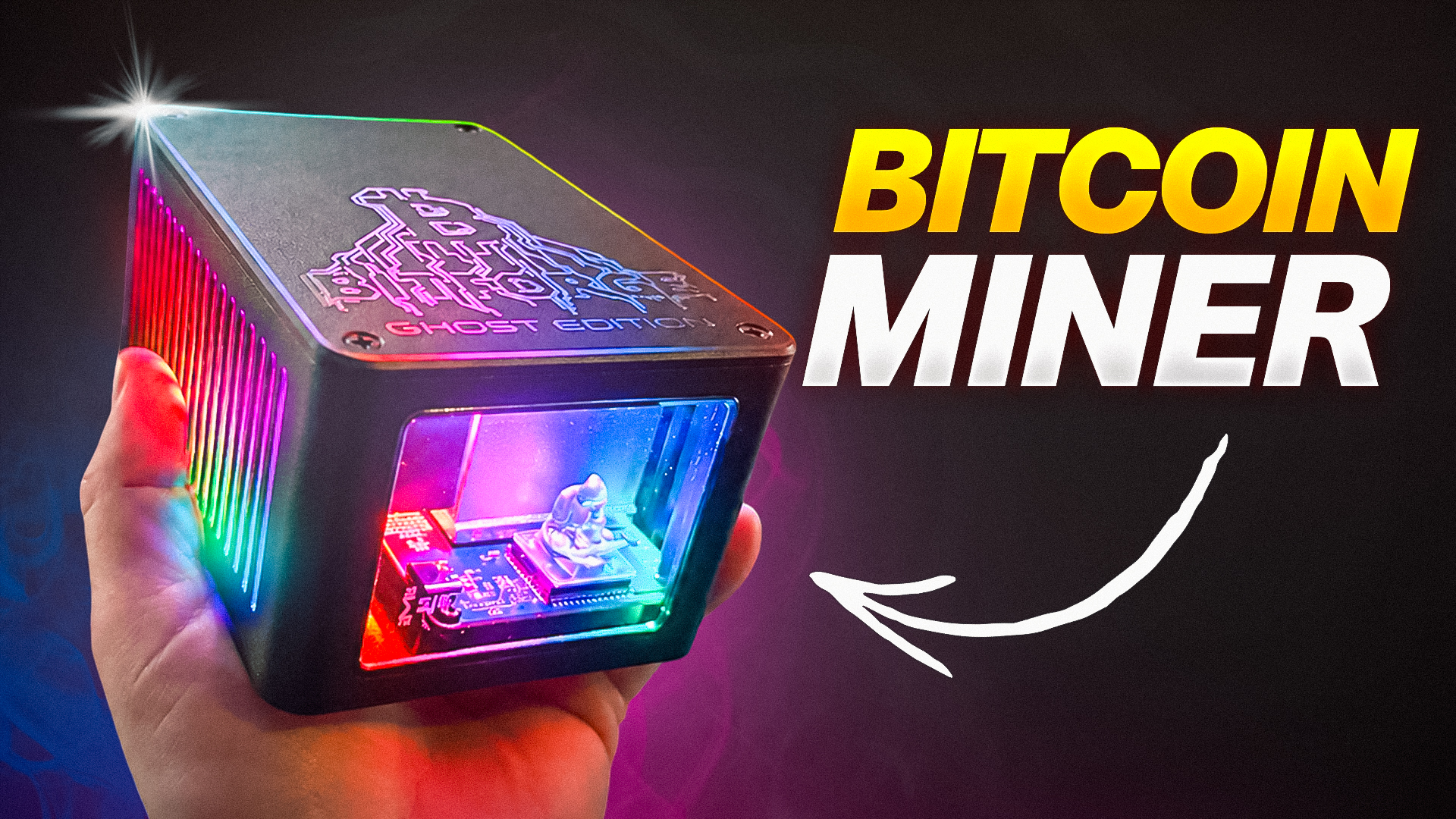
There are home Bitcoin miners, and then there are home Bitcoin miners that double as desk art. The BitForge Nano Ghost Edition is firmly in the second category — and it’s one of the most thoughtfully crafted pieces of mining hardware to land on the desk here at The Hobbyist Miner in a long time.
This thing has weight to it. Literal weight — the moment you pick up the box, you know something different is inside. That heaviness translates directly into build quality, and once you see what’s inside, it all makes sense.
For a full walkthrough and walkthrough setup, watch the video here: Bit Forge Nano Ghost Edition — Unboxing, Setup & Review
All Metal, Smoked Glass, and a Hidden Satoshi
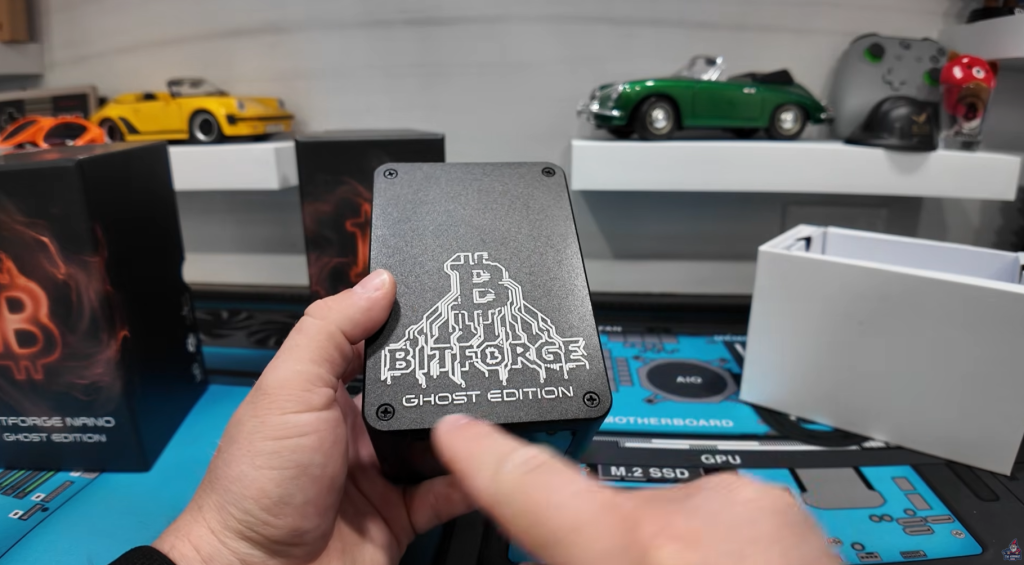
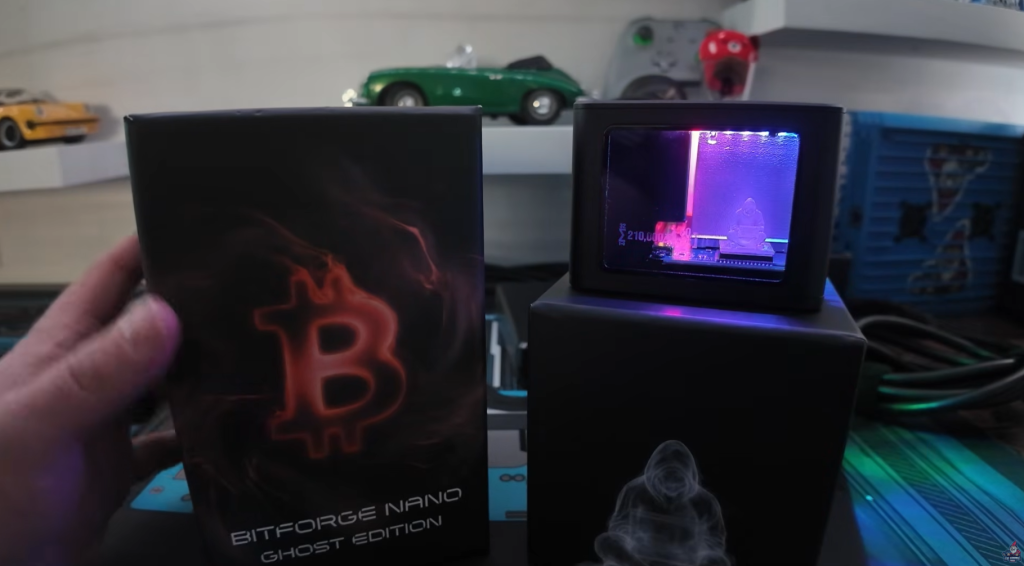
The Ghost Edition arrives in premium packaging — which matters, because the product inside justifies it. The enclosure itself is fully metal with a smoked glass top panel, a combination that immediately sets it apart from the plastic-heavy field of home miners. This is not a 3D printed case or an injection-molded shell. It’s the kind of hardware you’d actually want sitting on your desk.
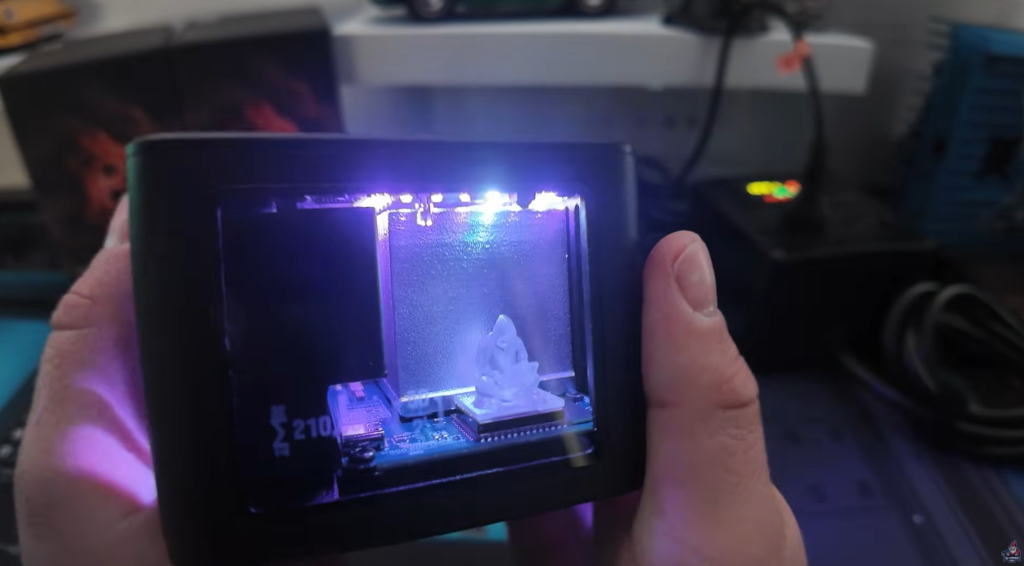
Four screws secure the top panel, and underneath that smoked glass sits the star of the show: a small sculptural figure of Satoshi Nakamoto — hooded, seated, laptop in hand. It’s a subtle detail until you plug the unit in and the RGB lighting floods the interior. Then it becomes the focal point of the entire piece.
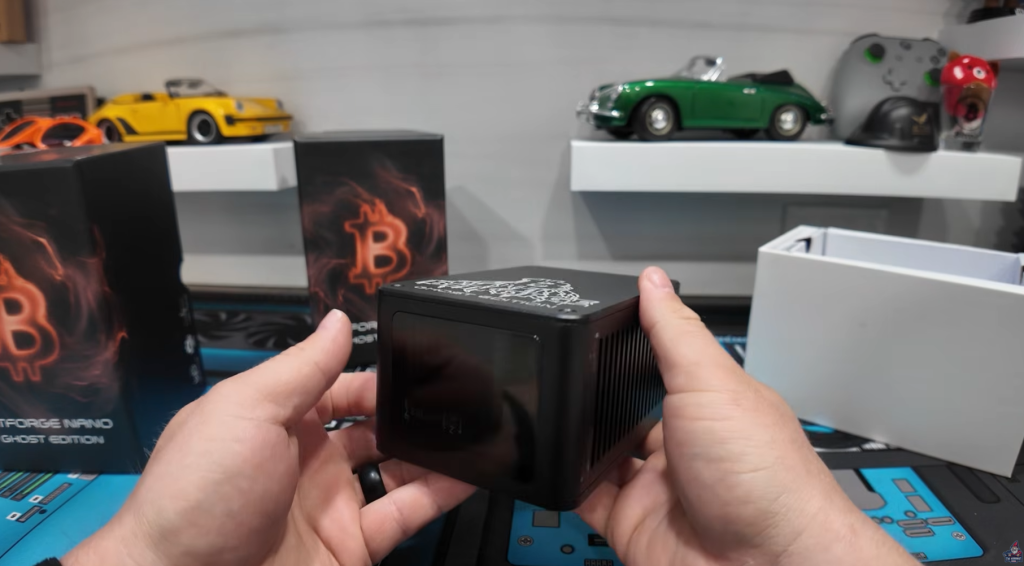
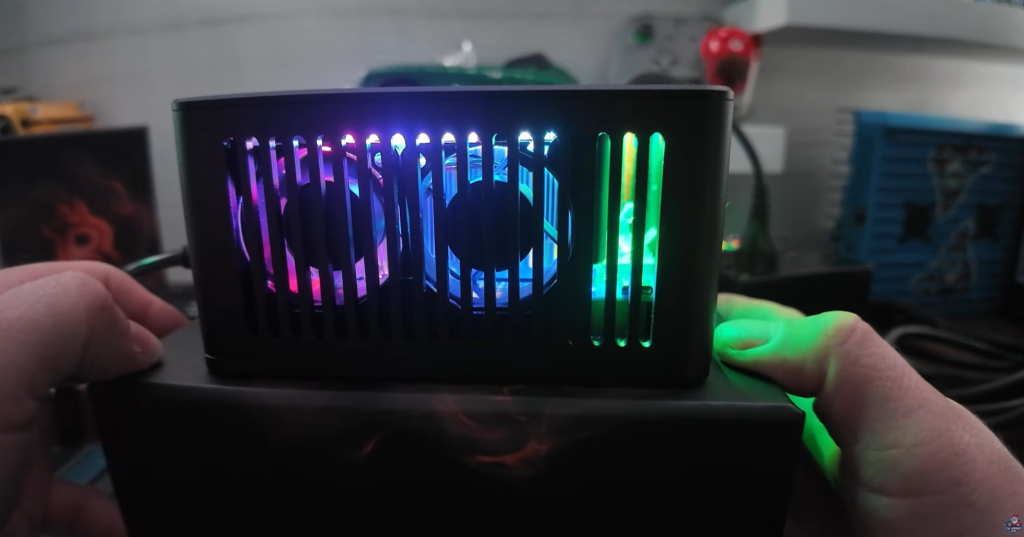
The sides of the enclosure feature open airflow channels exposing a large internal heatsink, with two fans visible on one face and ventilation grating on the back alongside a single power connector. The bottom panel carries the full hardware spec list, etched cleanly into the metal. Even the box includes a small booklet with design intent and team credits — a level of presentation rarely seen in this category of hardware.
The designer behind the Ghost Edition goes by IM GPIO — the same creator responsible for a number of standout home mining builds in recent years, including the Bit Chimney, the Mars Lander, the Bitforge Nano, and the Bitaxe Touch. The Ghost Edition continues that lineage of treating home mining hardware as something worth designing with care.
What’s Actually Inside?
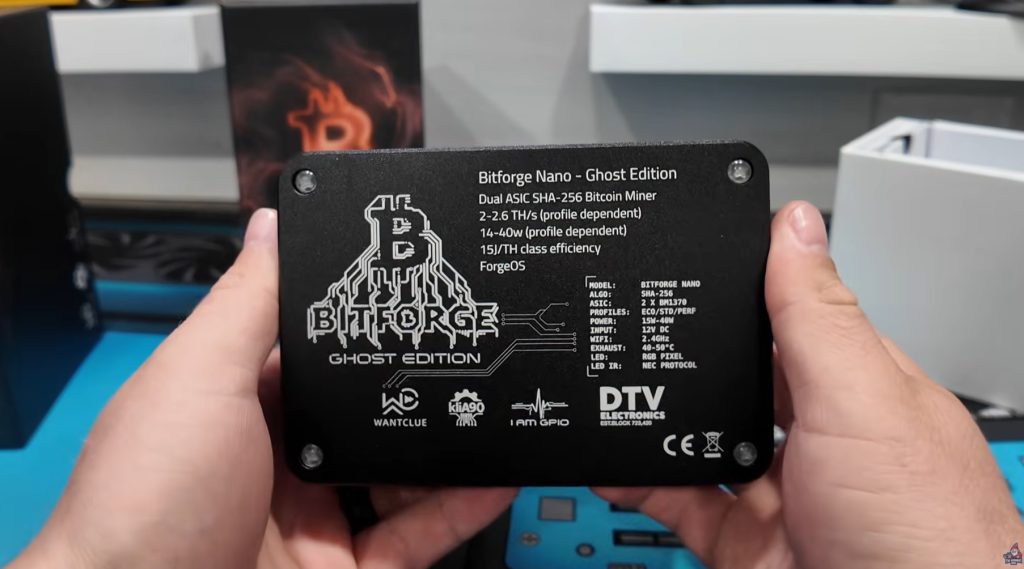
Under the hood, the Ghost Edition is a serious little miner. Here’s what you’re working with:
- Algorithm: SHA-256 (Bitcoin and other SHA-256 coins)
- ASIC chips: Two BM370 chips
- Hashrate: Up to 2.6 terahash (profile dependent)
- Power consumption: 15–40 watts (eco through performance mode), approximately 50 watts measured at the wall in power mode
- Noise level: 29 decibels rated; real-world testing confirmed 39–42 decibels at close range
- Wi-Fi: 2.4 GHz only (no Ethernet port)
- Operating system: ForgeOS
- Mining modes: Eco, Standard, and Power
- LED lighting: Full RGB with remote control included
The Ghost Edition also supports what’s called a swarm mechanic — a network discovery feature that identifies all compatible mining devices on your local network and displays them in a unified dashboard. Seeing hashrates, temperatures, and device names across an entire home mining fleet from a single view is a genuinely useful feature for anyone running multiple units.
Simple and Beginner Friendly Setup
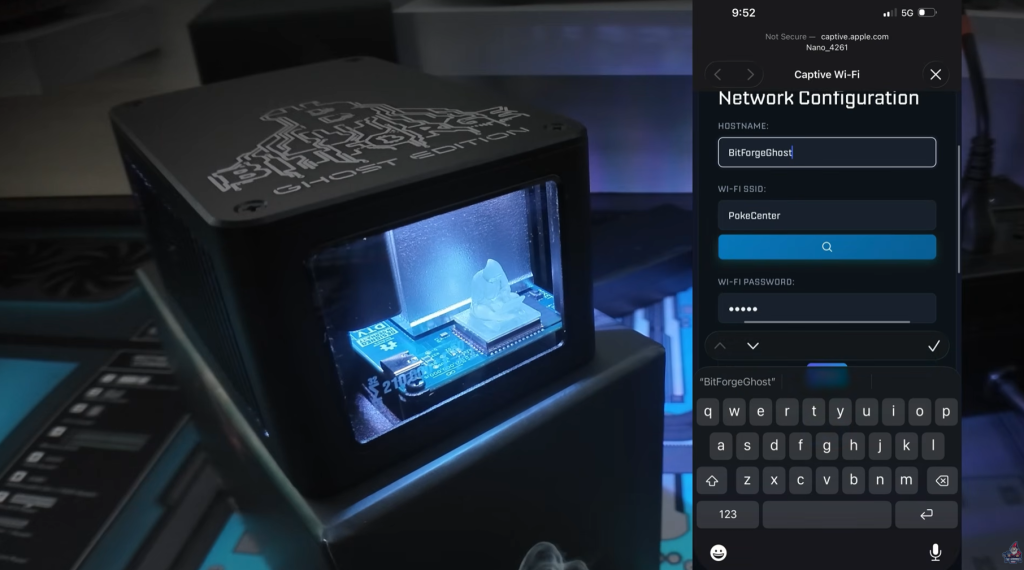
Getting the Ghost Edition online is straightforward. Once powered on, the unit broadcasts its own Wi-Fi network. Connecting to it from a phone or laptop opens a configuration page where you enter your home network credentials and pool settings. After a restart, the miner joins your local network and is accessible via its assigned IP address.
The ForgeOS web interface is clean, dark-mode by default, and shows everything you’d want at a glance: hashrate, efficiency, share data, temperature, uptime, and pool connection status. Power mode switching, fan control settings, and firmware updates are all handled from the same interface.
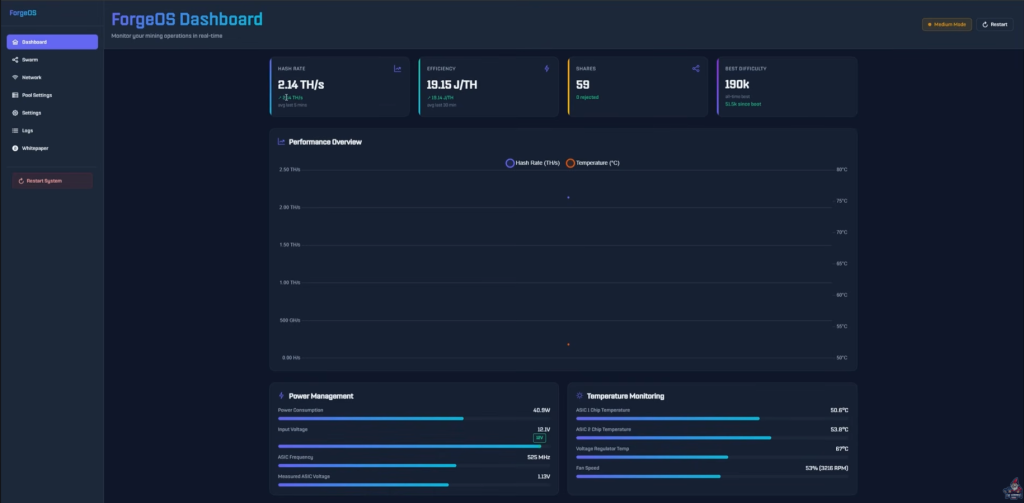
In testing, the miner reached its advertised 2.6 terahash within about 20 minutes of initial startup — right on spec. Firmware updated cleanly from version 1.0 to 1.1 through the interface without issue.
One note on overclocking: it is technically possible according to the manufacturer, but not officially encouraged. The cooling system is tuned specifically for the stock performance profile. Anyone interested in pushing beyond that is encouraged to reach out to the team directly for guidance.
Living With It Day to Day
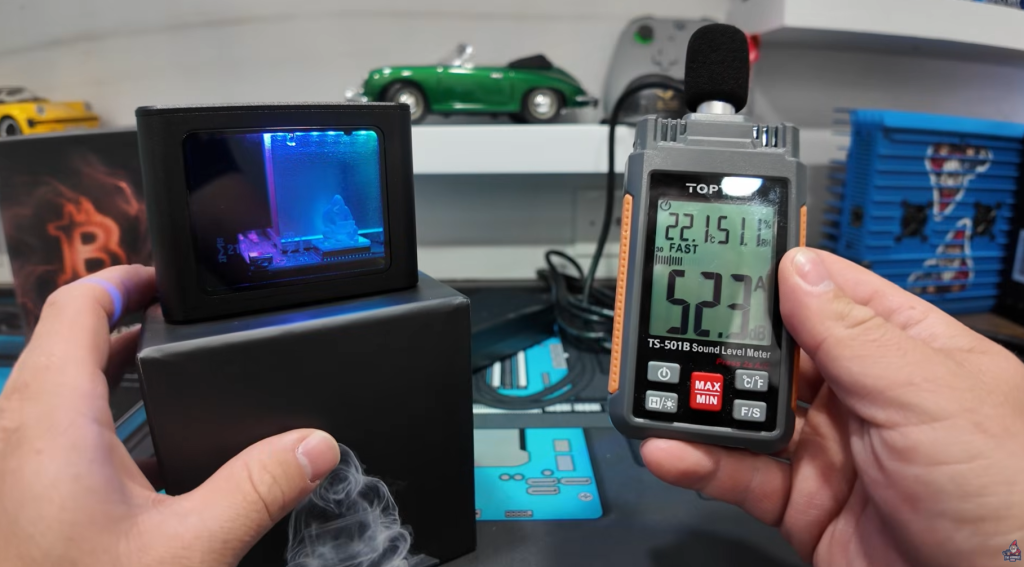
Two of the most practical questions about any home miner are how loud it is and what it costs to run. The Ghost Edition answers both favorably.
At close range — within a few inches — the unit measures around 40–42 decibels. Step back a couple of feet and that drops to approximately 39 decibels. The fans themselves aren’t particularly loud, but they do carry a slight high-frequency whine that’s the dominant sound from the unit. It’s not obtrusive, but it’s worth knowing if you’re planning to run this in a bedroom overnight.
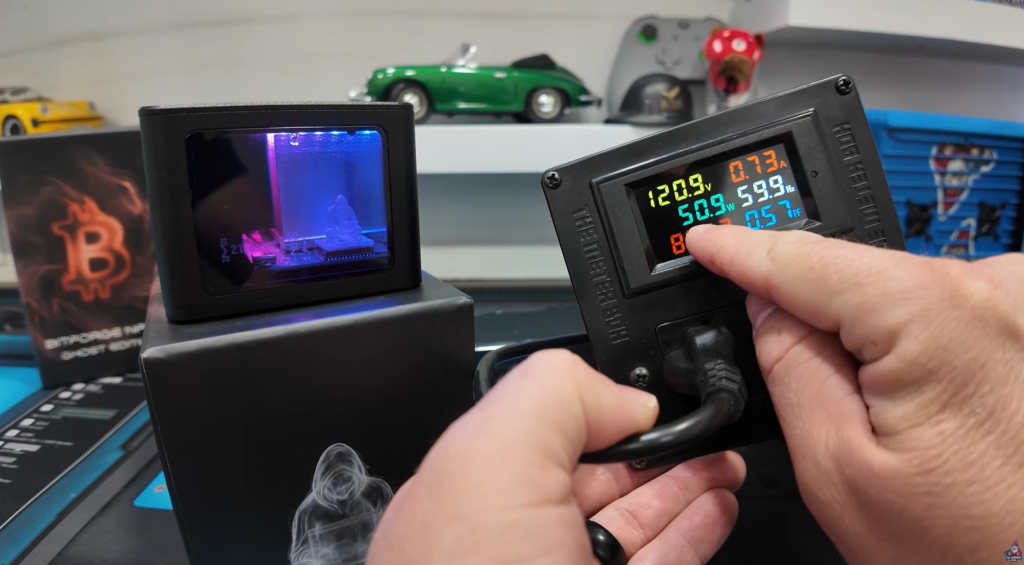
At the wall, the unit draws approximately 50 watts in power mode — slightly above the 40-watt spec listed for the top profile, but well within what’s expected from real-world testing versus manufacturer ratings. At 50 watts, monthly electricity costs are negligible for most users. This is comfortably in “run it and forget it” territory from a power standpoint.
What You’re Actually Buying
The Ghost Edition is designed specifically for solo Bitcoin mining — and it’s important to go in with clear expectations about what that means.
Solo mining means your miner competes independently against the entire Bitcoin network for the right to claim a block reward. At 2.6 terahash, the odds are long. There’s no pooled income, no steady trickle of small payouts. What you have is a real, ongoing chance at a significant reward, with the understanding that days, weeks, or months may pass between wins — if a win comes at all!
For the right kind of miner, that’s the appeal. The Ghost Edition can be pointed at your own home node — such as an Umbrel running Bitcoin Core with Mining Core Web GUI — keeping your mining entirely self-sovereign and off third-party pool infrastructure. A backup pool like CK Pool adds a failover layer without giving up the primary solo configuration.
This is Bitcoin mining the way it was originally intended to work: a single machine, a home connection, and a direct stake in the network.
Who the BitForge Nano Ghost Edition Is For?
The Ghost Edition occupies a very specific niche, and it fills it exceptionally well. If you’re looking for the highest hash-per-dollar ratio, there are more efficient options. If you want consistent pooled payouts, this isn’t the tool for that job either.
But if you want a beautifully built, whisper-quiet home Bitcoin miner that you’d genuinely enjoy having on your desk — something that blends hardware performance with real aesthetic intention — the Ghost Edition is in a category of its own right now.
At 2.6 terahash, 50 watts, under 42 decibels, and with an all-metal and smoked glass enclosure housing a hand-detailed Satoshi sculpture, it’s the kind of product that makes the home mining space feel like it’s growing up.
Check out the BitForge Nano Ghost Edition at The Solo Mining Company
🛒US ➡ https://geni.us/NanoGhostSoloSat
🛒EU ➡ https://geni.us/BitforgeNanoGhost
See You Next Time!
Have questions about the Ghost Edition or home solo mining in general? Come join the conversation in The Hobbyist Miner Community Discord — free to join here!