






Who Should Buy the Bitcoin Proto Rig? My Honest Take!

Welcome back, crypto miners and enthusiasts! 🚀 There’s a new contender shaking things up in the Bitcoin mining world, and today we’re deep diving into everything you need to know about it: the Proto Rig. Get ready to compare, dissect, and geek out over one of the most disruptive pieces of mining gear we’ve seen in a long time.
Whether you’re running a mega farm, tinkering at home, or just watching the industry’s every move, you’re going to want to stick around for my honest thoughts, a breakdown of the numbers, and why I genuinely think the Proto Rig is set to change the mining landscape for the better—even if you’re not planning to buy one (yet).
For more insights on this topic check out this detailed video:Who Should Buy the Bitcoin Proto Rig? My Honest Take!
Table of Contents
- Meet the Proto Rig: A New Challenger Enters
- Proto Rig at a Glance: Specs, Design, and First Impressions
- Power, Performance and Profitability: The Numbers Breakdown
- Weight, Construction, and What’s Inside?
- Comparison Time: Proto Rig Versus the Competition
- Pricing Mysteries and Availability
- Who Should Actually Buy the Proto Rig?
- Why Proto Rig’s Modularity Changes the Game
- Repairability, Warranty, and Customer Support
- US Manufacturing, Community Power, and Final Thoughts
- Major Industry News: Mining Disrupt 2025
Meet the Proto Rig: A New Challenger Enters

There’s a new kid on the block. A brand new manufacturer is here with an all-new Bitcoin miner, and the word is spreading fast. Bitmain—watch your back, because things are about to get interesting.
So what’s the hype all about? A few weeks ago, the mining world lit up with the announcement of the Proto Rig, crafted by a US-based manufacturer called Proto. Not only did they do a big online reveal, but they even held an invite-only in-person event. The buzz? Huge.
Let me put it this way: Proto Rig comes off as the Tesla of the bitcoin mining industry—focused on innovation, change, and customer service we haven’t really seen before in this space.
Checkout the Full Official Proto Live Stream Announcement Here
Proto Rig at a Glance: Specs, Design, and First Impressions
The Look and Feel
Right away, the Proto Rig doesn’t look like your usual mining hardware. If you’ve run a few Antminers or Whatsminers, you’ll spot the difference instantly. It’s big, it’s modular, and it’s full of components that pop in and out of the chassis in ways we’ve never really seen before.
Visiting their website throws you off a bit too—it’s proto.xyz, not your standard .com or even .io. They’re aiming for unique at every level.
Power, Performance, and Profitability: The Numbers Breakdown
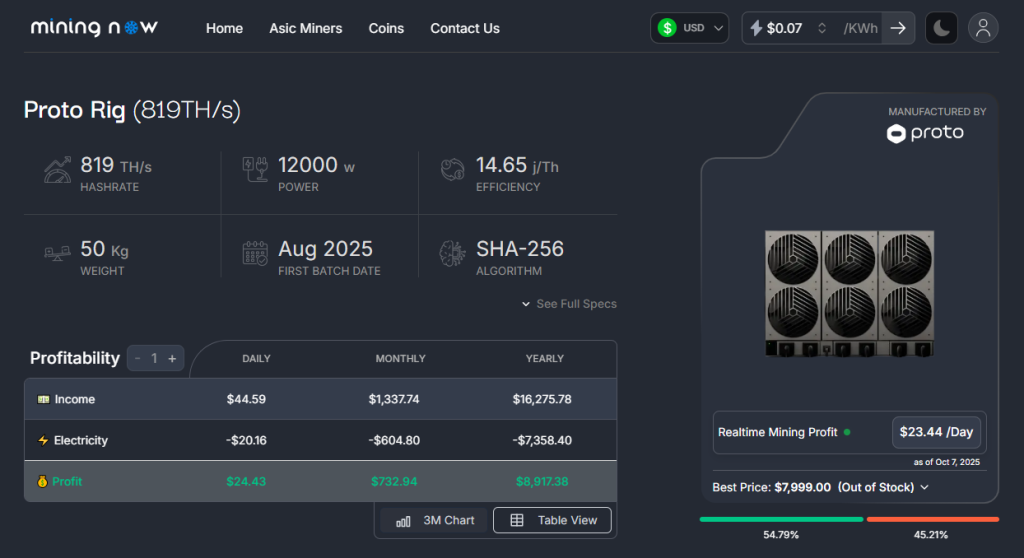
Let’s dig into the specs, because if you love numbers (and you should if you’re into mining), there’s plenty to talk about.
Performance Specs
- Hashrate: 819 TH/s (Air cooled)
- Power Consumption: 12,000 watts
- Efficiency: ~14.65 joules/TH
- Weight: 110 lbs
- Power Supplies: 3 x 4,000W PSUs
- Modular design: Yep, we’re talking true modularity
Now, let’s pause for a second. Did you catch those numbers? 819 terahash and 12,000 watts. We’ve gotten used to miners running at 200-300 terahash (with something like the S23), chewing up maybe 3,400 watts. Proto Rig is cranking out almost three S23s in one body—but with (wait for it) 12,000 watts of draw.
What Does This Mean for Your Electric Bill?
Let’s do some quick napkin math:
- At $0.07/kWh:
- Daily electricity cost: ~$20.16/day
- Monthly electricity cost: ~$604.80/month
- Yearly electricity cost: ~$7,358.40/year
And what does that electricity buy you in mining profits?
- Daily revenue: ~$44.22/day (As of October 7th 2025)
- Daily profit (after electricity): ~$24.44
If you’re familiar with the L9s, S21s, or S23s, you know they usually rack up $200-$250 a month in electricity. The Proto Rig? More like $600. But remember, we’re packing roughly three high-performance ASICs into a single (giant) machine.
Checkout this Video on the Proto Rig breaking down these numbers in more detail here
Weight, Construction, and What’s Inside?
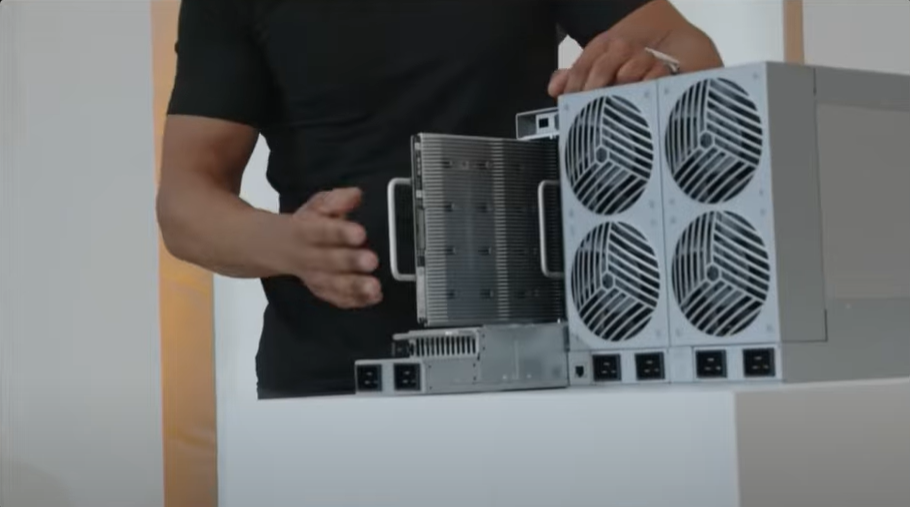
Heavyweight Construction
This rig isn’t just powerful—it’s a beast at 110 lbs packed full of tech:
- Three Power Supplies (that’s three times the beef)
- Three sets of fans
- Multiple hashboards
If you’ve lugged around a standard ASIC miner (typically 40-45 lbs), you know this is heavy. But again, you’re basically getting the muscle of three big miners squished into a single chassis.
Modular Madness
Inside, you’ll find a setup that isn’t just about raw numbers. Everything is designed to be modular, making it way easier to maintain, repair, or upgrade—which we’ll dive into more later.
Comparison Time: Proto Rig Versus the Competition
No new gear review is complete without putting it up against the best of the current crop. Let’s talk Bitmain’s S23 and S21XP—arguably the current leaders in air-cooled mining hardware.
Bitmain S23 vs. Proto Rig
- S23: 318 TH/s @ 3,498W (~11 J/TH)
- Proto Rig: 819 TH/s @ 12,000W (~14.65 J/TH)

The S23 is technically more efficient on paper at 11 joules per terahash versus Proto’s 14.65. But Proto Rig packs in 2.5x the hashrate in one chassis.
Bitmain S21XP vs. Proto Rig
- S21XP: 270 TH/s @ 3,645W (13.5 J/TH)
- Proto Rig: 819 TH/s @ 12,000W (~14.65 J/TH)
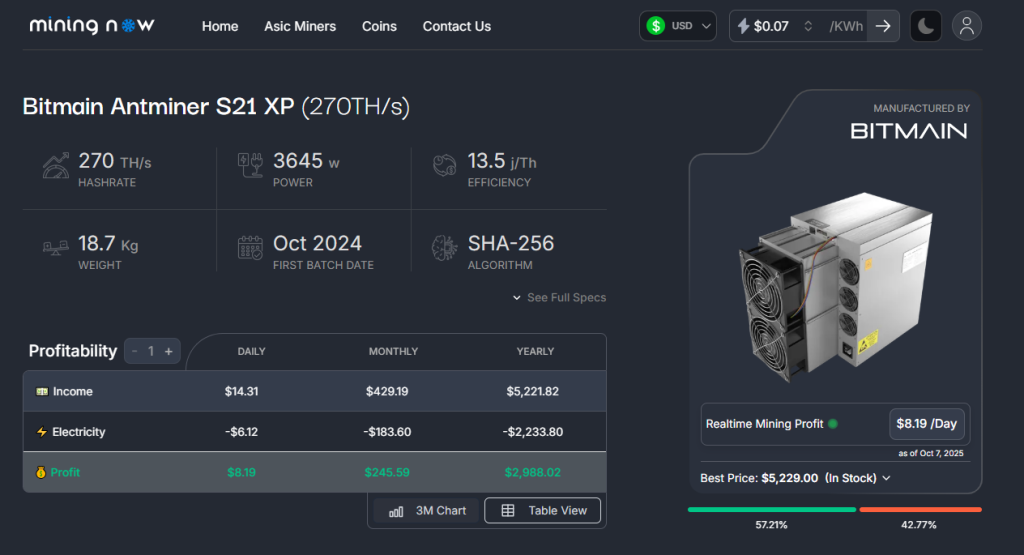
Now we’re a bit closer in efficiency. Proto Rig holds up well but loses just a hair on pure energy-per-hash performance.
Apples and Oranges?
But here’s the thing:
- You can’t just look at specs in a vacuum.
- Proto Rig is modular, repairable, and US-supported.
- It’s a new company; this is their first big product.
- There’s a lot more than numbers to consider, especially when thinking about big operations, uptime, and future-proofing.
Pricing Mysteries and Availability
So—how much does the Proto Rig cost? That’s been the big question, and honestly, we’re still not 100% sure.
- No official price on the Proto website.
- Resellers are estimating $7,999 (Crypto Miner Bros) up to $8,714 (Coin Mining Central) as oif October7th 2025
If those estimates are close to correct and include all the hashboards, you’re getting a screaming deal on hashrate-per-dollar—especially compared to S21XP or even L9s which are floating around $7,500 these days.
But (and it’s a big but): There’s still no easy “Add to Cart” button. It’s private sales only right now, requiring direct contact with their sales team on Proto’s Website.
Who Should Actually Buy the Proto Rig?
Let’s get real. Is the Proto Rig for you?
Home Miners: Maybe, But Probably Not
- 12,000 watts is a deal breaker for most households—unless you love the idea of running three dedicated 30A/240V lines in your garage.
- This thing is 110 lbs and built like a tank. Not exactly “plug-and-play” on a kitchen counter.
Hosting and Mining Farms: Now We’re Talking
- Three-phase power? Check.
- High-density racks and containers? Check.
- Massive hashrate in a smaller space? Super appealing.
- Easier, faster repair turnaround? Huge win.
If your interested in ASIC Hosting for your Miners, These are the 4 Companies I Use.
Hosting Companies
Some hosting companies may jump on this, but the real sweet spot is solo operators or big farms that can rack up enough Proto Rigs to make management, maintenance, and uptime a real concern—because the modularity and easy-swap components make a huge impact at scale.
“When you’re running hundreds or thousands of miners, every minute spent on repairs equals lost money. The Proto Rig’s swap-and-go design slashes that downtime.”
Why Proto Rig’s Modularity Changes the Game

Let’s dig deeper into what makes this rig stand out: insane modularity.
This is disucssed in more detail in the latest video: How this BTC Miner will Change Everything!
Tool-Free Operations
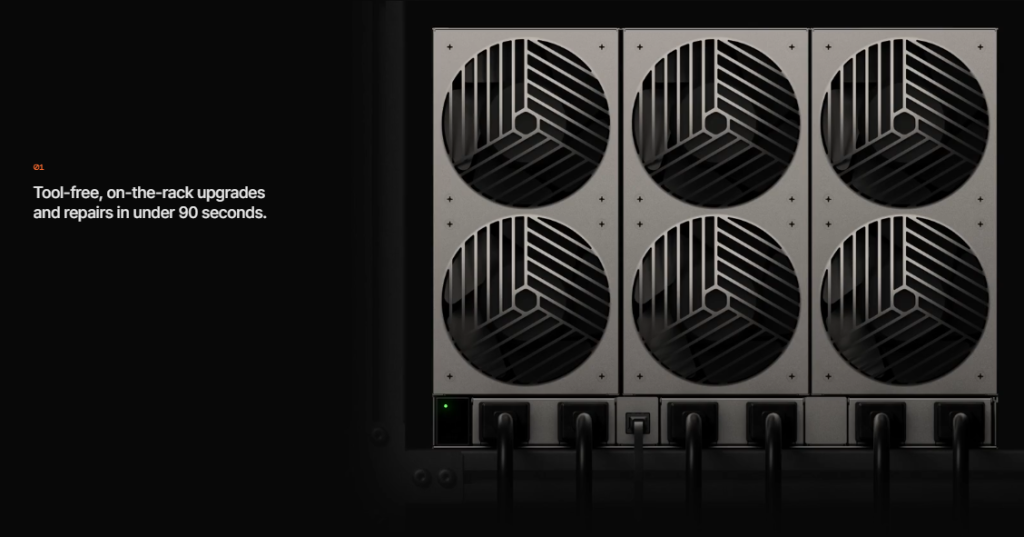
The Proto Rig is the first Bitcoin miner that really runs with the idea of true modularity. Everything—fans, hashboards, power supplies—can be swapped without a tool.
- Fans: Number one failure point for ASICs. Proto Rig made them hot-swappable cartridges. Push a button, pull out, snap in a new one. Boom—done in seconds, not minutes.
- Hashboards: The real breakthrough. Want to swap a damaged hashboard? No need to turn off the machine. Just slide it out, leave the rest running. It’ll even auto-balance the load and safely overclock the others while you wait.
- Power Supplies: Slide-in, slide-out modules that are custom-built for the Proto Rig. No second-hand PSUs or Chinese aftermarket clones.
Hot-Swapping (Seriously!)
Unlike anything we’ve ever had before, you can pull a hashboard for repair without shutting down the rig. The rest of the hashboards keep earning you money while you slap in a replacement—or, heck, just an upgraded hashboard when tech gets better.
Load Balancing
When running with a missing or bad hashboard, the Proto Rig auto-adjusts the remaining boards for maximum output. This cuts your downtime and keeps cash flow rolling.
Control Board, Too!
If that fails, it’s all modular and replaceable. The goal is never to ship out the whole box for repair—just slide out the bad bit, pop in a new one, and keep mining. No other miner lets you do this.
Repairability, Warranty, and Customer Support
Let’s be blunt: Repairability and customer support are the soft underbellies of most big mining manufacturers.
The Bitmain Problem
Bitmain (and many others) haven’t exactly been customer-champions here:
- Limited 30-day warranties
- Tough (and sometimes downright unhelpful) repair centers
- Parts shortages
- Push to scrap old units and buy new ones instead of fixing
Proto’s Big Promises
- 12-month warranty on all parts. Parts/swapouts are expected, and Proto says they back them.
- US-based support
- Quick repair via modular parts rather than full-unit RMA
Software Revolution: Fleet
And let’s not skip this next point—because it’s almost as big a deal as the hardware:
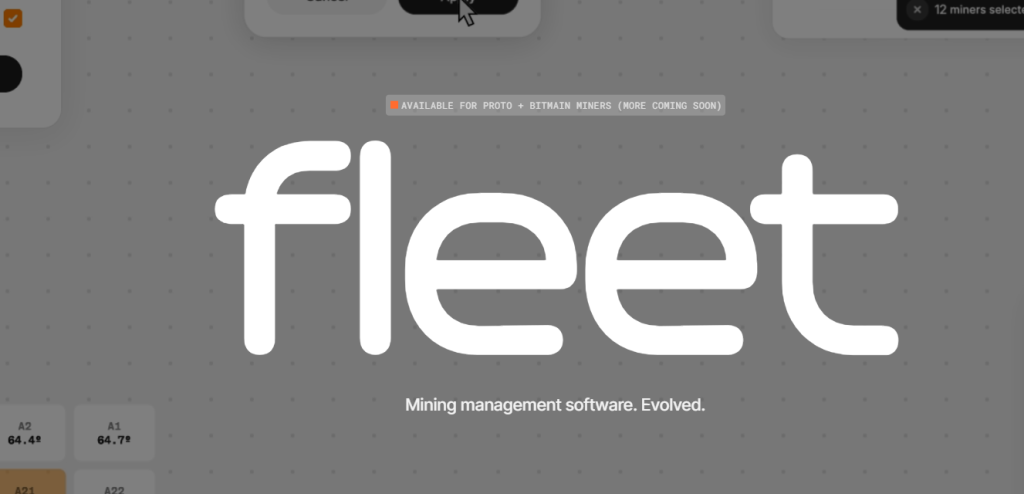
Fleet, Proto’s miner management app, was built in partnership with ex-Tesla, ex-Square, and ex-top 500 US tech talent. It’s cross-compatible, intuitive, and—for the first time—actually feels like customer-focused software.
- Replaces the old “Foreman” industry standard
- Can diagnose issues, offer step-by-step guides, and display diagrams for repairs
- Handles hundreds (or thousands) of units at scale
- Even tries to fix some problems in software before escalations
“Fleet is customer centric. It doesn’t just show you crazy log files—you actually get a real diagnosis and a path to fix it.”
Learn more about Fleet over on Proto’s website found here
US Manufacturing, Community Power, and Final Thoughts
So—why does all this matter? Why get excited, even if you’re not running out to buy a Proto Rig tomorrow?
Disruption Is Good
The mining world has been dominated by a few big players, mainly Bitmain, for years. Proto Rig steps in with real innovation:
- Repairability instead of disposability
- Long warranties and actual support you can reach
- US manufacturing and community-focused design
- Modular upgrades: When new tech comes out, replace just the hashboards, not the whole rig
- Better software for bigger operators
There’s huge upside, not just for big farms but for home miners too. More competition pushes Bitmain (and others) to offer better support, modularity, and warranties to everyone.
Upgradable for the Future
Unlike current miners, the Proto Rig is designed so you can eventually just slide out old hashboards and slide in upgraded ones as ASIC technology evolves. No need to buy a whole new chassis every 18 months. That’s a game changer for everyone who hates e-waste (and loves saving money).
What’s the verdict?
The Proto Rig isn’t for everyone—not yet. But it’s got the potential to trigger a new wave of innovation and customer service in mining. If nothing else, it raises the bar for the whole industry.
Are you buying one? Maybe not today. But keep your eyes peeled, because whether you’re running a home rig or an industrial farm, the days of clunky, hard-to-repair, fire-and-forget mining gear may finally be numbered.
If you’ve got thoughts, experiences, or spicy takes on the Proto Rig or other mining hardware, tweet at @Hobbyistminer on Twitter(X). And if you’re thinking about hosting or want a trustworthy US-based hosting facility, check out these trusted companies I use.
Thanks for reading! – Keep Growing, Learning and Mining!